

Selecting the right electronics contract manufacturer (CM) has never been more complex or more consequential. Today, the best partners do more than build products. They help customers preserve supply chain continuity, manage risk, and stay responsive in a volatile market.
Supply chain continuity as a core selection criterion
In today’s electronics manufacturing environment, supply chain continuity is a strategic priority, not just an operational concern. Geopolitical instability, trade disruptions, transportation delays, and regional conflicts can affect the availability of critical components and production timing.
A strong electronics CM helps customers manage those risks by maintaining sourcing flexibility, monitoring supplier health, and planning for disruptions before they happen. That includes identifying alternate sources when appropriate, tracking component availability, and helping protect production schedules when the market shifts unexpectedly.
Supply chain continuity also means planning for longer-term component risk. A qualified contract manufacturer should help customers manage lifecycle challenges such as obsolescence, end-of-life parts, and changing compliance requirements, ensuring their Bill of Materials (BOM) remains viable over time and production doesn’t stall midstream.
Tariff management and mitigation
Tariff management is another factor worth weighing. If tariffs aren’t part of your contract manufacturer’s sourcing conversations, they should be.
Tariff exposure cannot be determined by country of origin alone. Applicable duties may depend on a component’s classification, materials, origin, and relevant trade programs, while rates and exclusions can change frequently. A capable electronics CM will review your BOM and approved vendor list, identify tariff exposure, and offer to evaluate qualified alternative sources.
When approved alternatives are available, strategic sourcing can reduce landed costs while maintaining quality and production continuity. However, shifting purchases to unfamiliar suppliers or distribution channels can increase counterfeit and traceability risks. A qualified contract manufacturer can combine tariff mitigation with authorized sourcing, supplier verification, counterfeit-component detection, and rigorous change-control procedures to control costs without compromising quality, traceability, or supply chain reliability.
Collecting tariff refunds
The U.S. government’s tariff refund program adds another layer of complexity. If your CM is the importer of record, it may be eligible to recover IEEPA duties paid on qualifying entries.
U.S. Customs and Border Protection launched the first phase of its CAPE refund process within the ACE portal on April 20, 2026. Eligibility depends on factors such as entry type and liquidation status, and navigating the process requires both awareness and follow-through. When evaluating CMs, ask directly:
- Do you have a process for identifying and submitting eligible tariff refund claims?
- How are recovered duties and interest credited or allocated to customers?
An electronics manufacturing partner that proactively communicates tariff exposure in its quotes, monitors regulatory changes, and pursues available refunds demonstrates the financial stewardship needed to help protect your margins.
Turnkey capabilities help manage complexity
Given that backdrop, turnkey capabilities deserve greater consideration during the selection process. The most capable electronics contract manufacturers today aren’t just assemblers; they act as end-to-end turnkey partners who keep production moving and manage costs when supply chains are under pressure.
A turnkey contract manufacturer can handle sourcing, procurement, assembly, testing, and final delivery, allowing for tighter coordination across the production process. That level of control can improve speed, simplify communication, and make it easier to respond to component shortages, changing demand, or unexpected disruptions.
Look for a contract manufacturer that takes ownership of the supply chain, from managing the Approved Vendor List through final delivery, and has the infrastructure to manage complexity at scale.
Automation investments advance accuracy
Labor costs are a persistent pressure in electronics manufacturing, and CMs investing in automation are best positioned to remain competitive, including compared to offshore alternatives.
Surface mount technology (SMT) lines and selective soldering equipment are the foundation of any modern electronics and PCB assembly operation, but leading CMs go further with inline robotics, automated material handling, and automated final assembly, such as labeling, box builds, testing, and programming, that can meaningfully reduce per-unit labor costs at volume.
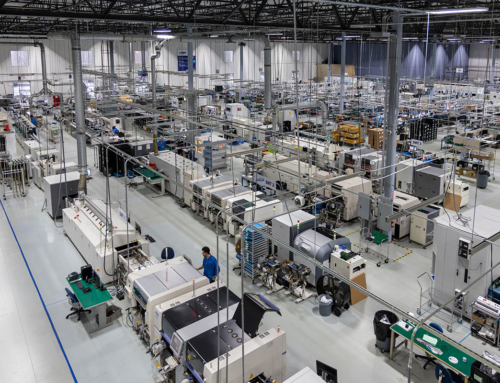
CO-AX Technology illustrates what this looks like in practice. Its Solon, Ohio facility integrates hardware and software automation to improve quality and reduce costs. Multiple automated SMT lines, inline robotics, storage carousels for efficient kitting, ICT, FCT and AOI, alongside advanced MES, supply chain intelligence and design automation, reflect the company’s commitment to keeping pace with customer needs through equipment, software and workforce development.
When evaluating a CM’s automation capabilities, ask not just what equipment they have, but whether they’re actively applying it to solve specific problems for their customers.
Engineering support and NPI
Automation and cost management cannot compensate for a CM that gets involved too late. CMs with design-for-manufacturing (DFM) expertise can identify and resolve issues before they become costly production problems.
Look for a CM that engages your engineering team early, offers feedback on component selection and board design, and has dedicated NPI capacity rather than treating it as a distraction from production runs. Look also for lifecycle management capabilities, including obsolescence forecasting and regulatory compliance monitoring, so your BOM stays current and you’re not caught off guard by end-of-life components mid-production. This capability is especially valuable for companies launching new products or transitioning designs from prototype to volume.
Quality systems and certifications
A CM’s quality infrastructure is a baseline indicator of operational maturity. ISO 9001 certification is standard; it signals that the CM has documented processes, conducts internal audits, and undergoes third-party review. Don’t overlook this, and don’t be shy about asking when their last audit occurred. Beyond certification, ask how the CM handles traceability. A best-in-class operation tracks every step from receipt of raw materials through shipment of finished goods, with full visibility into labor and product yield at each stage.
CO-AX operates a Quality Management System certified to ISO 9001 (with Design) and ISO 13485 (without Design). In addition, the company is certified for its Environmental Management System (ISO 14001) and a host of other regulatory and technical certifications.
An electronics contract manufacturer that puts it all together
The right electronics contract manufacturer treats your business as a partnership, not a transaction. That means helping preserve supply chain continuity, managing tariff exposure and refunds, investing in automation to reduce your costs over time, and supporting your engineering team from NPI through production.
These aren’t just differentiators. In today’s environment, they’re table stakes for a partner that expects to grow alongside you.
CO-AX Technology brings all of these capabilities under one roof, with a team that takes a proactive approach to supply chain continuity, offers expert engineering support, and provides turnkey production efficiencies that help control costs without sacrificing quality.
If you’re evaluating electronics contract manufacturing partners, we’d welcome the conversation. Let’s get started.